
Washington Monument: History, Facts & the Story Behind It
Robert DeckerWashington Monument: The Surprising Story Behind America’s Iconic Obelisk
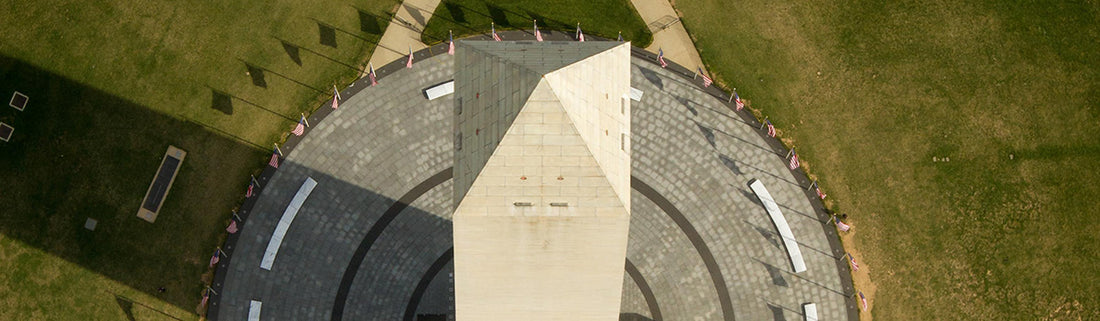
Few structures define Washington, D.C. quite like the Washington Monument. Rising more than 555 feet above the National Mall, the massive marble obelisk honors George Washington and anchors one of the most recognizable landscapes in the United States.
Its clean, simple silhouette makes it look almost inevitable—as though it was always meant to be there.
The truth is much more interesting.
The Washington Monument took decades to complete, survived funding failures, political turmoil, redesigns, and a long construction stoppage, and even ended up with two noticeably different shades of marble.

Construction began in 1848, stopped for more than two decades, resumed under federal direction in the late 1870s, and was finally completed in 1884. At 555 feet, 5⅛ inches, it became the tallest building in the world at the time.
A Monument Worthy of George Washington
The idea of building a major national memorial to George Washington emerged not long after his death.
In 1833, the private Washington National Monument Society formed with an ambitious goal: create a monument to the nation's first president that would be unlike anything else in the world.
Architect Robert Mills was chosen to design it.
His original concept was far more elaborate than the monument we know today. It called for a towering Egyptian-style obelisk surrounded by a circular colonnade filled with statues of Revolutionary War heroes and signers of the Declaration of Independence.
Eventually, the plan was simplified to the elegant obelisk we recognize today.
The form was inspired by ancient Egyptian monuments and was intended to convey permanence, strength, and timelessness—a fitting architectural language for honoring the nation's first president.
Construction Begins in 1848
The cornerstone was laid on July 4, 1848, during a major public ceremony attended by President James K. Polk, members of Congress, military units, and thousands of spectators.
Construction moved upward as donations came in.
Then the money ran out.
The Monument That Sat Half-Finished for Decades
By the 1850s, fundraising had slowed dramatically and the Washington National Monument Society was struggling financially.
Construction eventually stopped, leaving an unfinished marble shaft standing about 150 feet high.
Then came the Civil War.
For more than two decades, the half-built monument stood on the Mall as an awkward reminder of an ambitious project that seemed unlikely ever to be completed.
You can still see the construction break. The marble above roughly the 150-foot level is a slightly different color because later builders had to obtain stone from different quarry sources.
Congress Steps In
As the country approached the centennial of American independence, enthusiasm for completing the monument returned.
In 1876, Congress agreed to take responsibility for funding and completing the project.
Lieutenant Colonel Thomas Lincoln Casey of the U.S. Army Corps of Engineers eventually took charge. Before adding more height, Casey strengthened the foundation and modified Mills' original design into a more classically proportioned obelisk.
Construction resumed in earnest in 1880.
The Washington Monument Timeline
- 1848: Cornerstone laid and construction begins
- 1850s: Funding problems bring construction to a halt
- 1876: Congress assumes responsibility for completing the monument
- 1880: Construction of the shaft resumes
- December 6, 1884: Capstone and aluminum tip installed
- February 21, 1885: Washington Monument formally dedicated
- 1886: First public access to the interior
- 1888: Monument reopens with a passenger elevator
The Tallest Building in the World
On December 6, 1884, workers placed the 3,300-pound marble capstone at the summit.
Then came one final—and surprisingly modern—touch.
An 8.9-inch aluminum pyramid was placed on top.
Today, aluminum is everywhere. In 1884, however, it was still difficult and expensive to produce. The small metal tip was considered an impressive piece of technology and one of the largest aluminum castings of its day.
When construction ended, the monument stood at precisely 555 feet, 5⅛ inches.
It surpassed Germany's Cologne Cathedral and became the tallest building in the world—a distinction it would hold until the Eiffel Tower was completed in 1889.
The very top of one of America's most recognizable monuments was capped with what was, at the time, a remarkably rare and high-tech material: aluminum.
Why the Monument Still Feels So Powerful
There is something remarkable about the simplicity of the Washington Monument.
No elaborate sculpture covers its exterior. No enormous inscription explains what you're supposed to feel.
It is simply an enormous geometric form rising above the Mall.
And that restraint may be exactly why it works.
From almost anywhere on the National Mall, the monument becomes a visual reference point. It connects the White House, Capitol, Lincoln Memorial, reflecting pools, museums, and surrounding memorial landscape.
It is less a building than a landmark—and one that has come to symbolize Washington, D.C. itself.
George Washington and the Nation He Helped Create
The monument honors a figure whose military and political leadership played a central role in the founding of the United States.
Washington commanded the Continental Army during the Revolutionary War and later became the nation's first president, serving from 1789 to 1797.
Perhaps just as importantly, his presidency helped establish traditions for a new national government—including the peaceful transfer of executive power when he voluntarily stepped down after two terms.
The Washington Monument was designed to turn that historical legacy into something visible: a landmark intended to endure across generations.
Visiting the Washington Monument
Standing beneath the monument gives you one perspective.
Going to the top gives you another.
Today's elevator makes the climb dramatically easier than it was for early visitors, who once had to climb hundreds of stairs through the interior.
From the observation level near the top, visitors can look across the monumental core of Washington, D.C., including views toward the White House, U.S. Capitol, Lincoln Memorial, Jefferson Memorial, and Potomac River.
Entrance procedures, ticket requirements, operating hours, and temporary closures can change. Check the National Park Service's current Washington Monument information before heading to the Mall.
Bring the Washington Monument Home
The Washington Monument is exactly the kind of subject that lends itself to poster design.
Its shape is unmistakable. Strip away nearly everything else and you still know exactly what you're looking at.
That simple, powerful silhouette is what inspired my Washington Monument Poster.

Inspired by the bold visual language of classic WPA-era travel and National Park artwork, the design celebrates one of the most recognizable landmarks in the nation's capital.
Frequently Asked Questions About the Washington Monument
How tall is the Washington Monument?
The Washington Monument stands 555 feet, 5⅛ inches tall.
When was the Washington Monument built?
Construction began in 1848 and was completed on December 6, 1884. The monument was formally dedicated on February 21, 1885.
Why are there two different colors of stone on the Washington Monument?
Construction stopped for more than two decades. When work resumed, builders obtained marble from different quarry sources, creating the visible color change partway up the monument.
Who designed the Washington Monument?
Architect Robert Mills created the original design. Lieutenant Colonel Thomas Lincoln Casey of the U.S. Army Corps of Engineers later oversaw the engineering and completion of the monument.
Why is the Washington Monument shaped like an obelisk?
The design was inspired by ancient Egyptian obelisks, whose tall, simple forms conveyed permanence and grandeur.
Was the Washington Monument once the tallest building in the world?
Yes. When completed in 1884, it surpassed Cologne Cathedral and became the tallest building in the world. The Eiffel Tower surpassed it in 1889.
What is on top of the Washington Monument?
The marble capstone is topped with a small aluminum pyramid installed in 1884, when aluminum was still rare and expensive.
Love America's National Parks?
Join 125K+ fellow National Park enthusiasts for park stories, travel inspiration, new artwork, special offers, and more.