Dry Tortugas National Park: Fort Jefferson, Snorkeling & Seaplane Adventure
Robert DeckerAlmost 70 miles west of Key West, beyond the end of the Florida Keys, a massive red-brick fortress appears to rise directly from turquoise water.
This is Dry Tortugas National Park — one of the most remote, unusual, and rewarding national parks in America.
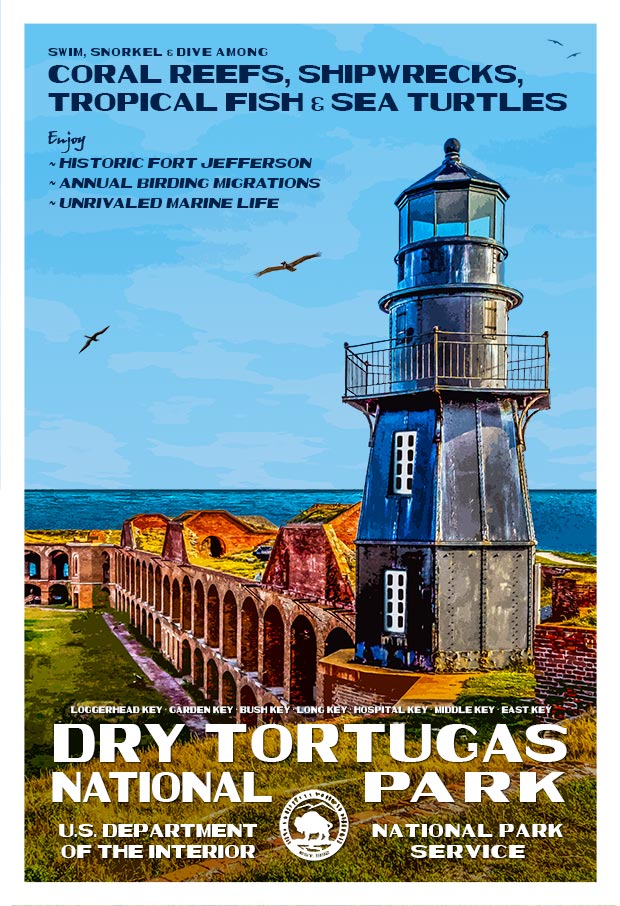
The park protects seven small islands surrounded by coral reefs, seagrass beds, shipwrecks, sea turtle habitat, and remarkably clear water. At its center stands Fort Jefferson, an enormous 19th-century coastal fortress covering much of tiny Garden Key.
There are no roads to Dry Tortugas. No hotels. No restaurants. And no casual decision to swing by while you're in the neighborhood.
You arrive by boat or seaplane — and getting there is part of the adventure.
Hi, I'm Rob Decker. I've spent more than 50 years exploring and photographing America's national parks, and my trip to Dry Tortugas remains one of the most memorable. I chose to fly from Key West by seaplane, landed on the water beside Fort Jefferson, explored the fort almost alone in the early morning, and finished the visit snorkeling in the warm, clear water surrounding Garden Key.
Dry Tortugas National Park is roughly 100 square miles — but less than 1% of it is dry land. The overwhelming majority of this national park is ocean.
Dry Tortugas National Park at a Glance
- Location: Almost 70 miles west of Key West, Florida.
- Getting There: Ferry, seaplane, private boat, or permitted charter.
- Main Destination: Garden Key, home to historic Fort Jefferson.
- Don't Miss: Fort Jefferson, snorkeling, the moat wall, beaches, birdlife, and the view arriving from the air or sea.
- Recommended Time: A full-day trip if possible; overnight camping offers an entirely different experience.
- Camping: Primitive camping is available on Garden Key. Campers must bring their own food, drinking water, and supplies.
- Best Advice: Plan early. Transportation capacity is limited and reservations can fill well in advance.
How Do You Get to Dry Tortugas National Park?
Dry Tortugas is one of the few national parks in the country that you simply cannot drive to.
Most visitors begin in Key West and choose between the daily ferry and a seaplane flight. Travelers with their own boats or those using authorized charters have greater flexibility and can potentially explore areas beyond Garden Key.
The ferry offers a full-day experience and carries more passengers and gear. The seaplane is considerably faster and gives you an extraordinary aerial view of the shallow waters, reefs, islands, shipwrecks, and marine life between Key West and Fort Jefferson.
I chose the seaplane.
And for a photographer, that turned out to be a very good decision.
My Seaplane Flight from Key West to Dry Tortugas
I checked in early for a morning flight from Key West. It was late March, the sun was just rising, and wisps of pink and orange clouds were beginning to pick up the first light of the day.
There were only ten passenger seats aboard our De Havilland Turbine Otter amphibious aircraft — and when the co-pilot seat was offered, I jumped at the opportunity.
Seat belt fastened. Headphones on. Camera ready.
Within minutes we were airborne.
From the cockpit, Key West spread out below me before quickly receding into the distance. Hotels, streets, and familiar landmarks gave way to the shallow blue and green waters surrounding the Florida Keys.
And then our pilot decided Tom Petty's Free Fallin' would be appropriate background music for the flight.
Not necessarily the song I would have chosen at that particular moment.
Flying low above the water completely changed my sense of the landscape. In some areas the sea was only a few feet deep, and from our low altitude we could look down into extraordinarily clear water. Sea turtles appeared below us, their silhouettes surprisingly easy to distinguish against the sandy bottom.
Farther west, the islands became smaller and the water seemed to stretch endlessly in every direction.
Then Fort Jefferson appeared on the horizon.

Even from the air, it's difficult to comprehend the scale of the fort. A huge six-sided brick structure occupies most of Garden Key, surrounded by a moat and impossibly blue water.
Our pilot banked around the island before lining up for landing. The pontoons touched the water so smoothly that it barely felt like we'd landed at all.
A few moments later, we were on the beach.
It was still early enough that, aside from our small group, several campers, and National Park Service staff, Garden Key felt almost deserted.
Watching the seaplane take off again and disappear toward Key West drove home just how isolated we really were.
1. Explore Fort Jefferson
Fort Jefferson dominates Garden Key — physically, visually, and historically.
Construction began in 1846 as the United States sought to protect the strategically important shipping routes connecting the Gulf of Mexico, Caribbean, and Atlantic. The location made sense militarily: ships entering or leaving the Gulf passed through waters near the Dry Tortugas.
The scale of the project was extraordinary. More than 16 million bricks went into Fort Jefferson, making it the largest masonry structure in the Americas.
And it was never finished.
Construction continued for decades amid difficult conditions, shifting foundations, storms, supply problems, changing military technology, and the Civil War. Enslaved laborers from Key West made up much of the workforce during the fort's early years, followed later by soldiers, civilian laborers, and prisoners.
Walking through the fort today reveals seemingly endless brick corridors, archways, gun rooms, staircases, casemates, and enormous open spaces overlooking the sea.

Take time to walk the upper levels. From the top of the fort, the view opens into a remarkable 360-degree panorama of Garden Key, Bush Key, surrounding reefs, and miles of open water.
With almost nothing else breaking the horizon, you begin to appreciate how exposed — and strategically important — this lonely outpost once was.
2. Discover the Civil War History of Fort Jefferson
Although Fort Jefferson never fired upon an enemy warship, it played an important role during the Civil War.
Union forces maintained control of the fort throughout the conflict, helping secure vital shipping lanes. It also became a military prison.
Its most famous prisoner was Dr. Samuel Mudd, the Maryland physician who treated John Wilkes Booth's broken leg after Booth assassinated President Abraham Lincoln. Mudd was convicted of conspiracy and imprisoned at Fort Jefferson from 1865 until 1869.
During a devastating yellow fever outbreak in 1867, Mudd helped care for the sick after the fort's physician died from the disease. His sentence was later commuted, and he was released in 1869.
The U.S. Army abandoned Fort Jefferson in 1874, although the site continued to serve various military, quarantine, and navigational purposes in subsequent decades.
3. Why Is It Called Dry Tortugas?
The name itself tells part of the park's story.
Spanish explorer Juan Ponce de León reached these islands in 1513 and called them Las Tortugas — "The Turtles" — because of the abundance of sea turtles in the surrounding waters.
The word Dry was later added to nautical charts to warn mariners that the islands had no dependable source of fresh water.
Sea turtles remain an important part of the ecosystem today. Loggerhead, green, hawksbill, leatherback, and Kemp's ridley sea turtles occur in South Florida waters, and several species may be seen around Dry Tortugas.
The park is also an important sea turtle nesting area within the Florida Keys.
Look, don't disturb: Sea turtles and their nests are protected. Give turtles plenty of space in the water and on shore, and never approach or interfere with nesting wildlife.
4. Snorkel Around Garden Key
Dry Tortugas is just as remarkable below the surface as it is above it.
After exploring Fort Jefferson, I headed to the west side of Garden Key for a swim and snorkel.
Warm, clear water makes the areas around Garden Key accessible to snorkelers of many experience levels. Coral, seagrass, tropical fish, and historic structures create a fascinating mixture of natural and cultural resources.
One particularly interesting area lies around the remains of historic coaling piers. The U.S. Navy constructed piers and warehouses here during the late nineteenth century to refuel ships. Storms eventually destroyed the structures, but submerged pilings remain.
Today those pilings provide habitat for marine life. Depending on conditions, snorkelers may encounter grouper, tarpon, barracuda, reef fish, nurse sharks, corals, sea fans, and other species.
The outside of Fort Jefferson's moat wall is another popular snorkeling area. Swimming inside the moat is prohibited, but the waters outside the wall can provide excellent opportunities to explore the marine life surrounding the fort.
Snorkeling Tip: Never touch or stand on coral, don't collect shells or historic objects, and always use the buddy system. Conditions change with tides, wind, visibility, and weather, so check current guidance when you arrive.
5. Watch One of America's Great Bird Migrations
Dry Tortugas may look like a handful of tiny islands in an enormous ocean, but to migrating birds those specks of land can be critically important.
More than 300 species have been documented in the park, including migrants that stop here while crossing between North America, the Caribbean, and Central or South America.
Spring migration can be especially exciting. When weather forces migrating songbirds to stop on the islands, an astonishing variety of species may appear in a very small area.
Bush Key, immediately adjacent to Garden Key, supports one of the park's most spectacular natural events.
Each year, tens of thousands of sooty terns and thousands of brown noddies arrive to nest. Bush Key typically closes during nesting season — roughly February through September — so the birds can reproduce without disturbance.
Even when the island is closed, the spectacle is visible from Garden Key. Through binoculars or a long camera lens, you can watch thousands of birds filling the sky above the island.
6. Walk the Beaches and Moat Wall
You don't need a long trail to explore Garden Key.
Walk the shoreline, circle portions of Fort Jefferson along the moat wall, and spend time simply looking across the water. Because the island is so small, you can move easily between history, swimming, snorkeling, beaches, and birdwatching.
The constantly changing combination of brick, white sand, blue-green water, and sky makes Garden Key especially photogenic.
For photographers, early and late light can be extraordinary. Campers have the added advantage of being on the island after day-trip visitors depart and before they return the following morning.
7. Camp on Garden Key
If a day trip feels remote, imagine staying after the ferry and seaplanes leave.
Primitive camping is available on Garden Key just outside Fort Jefferson. There are no hotels or lodges inside Dry Tortugas National Park, so camping is the only way most visitors can spend the night.
The experience comes with responsibility: campers must arrive self-sufficient.
What to Know About Camping at Dry Tortugas
- Bring Your Own Water: There is no dependable fresh drinking-water supply for campers.
- Bring All Food: There are no restaurants or grocery stores in the park.
- Bring Your Gear: Tents, sleeping equipment, cooking supplies, and other necessities must come with you.
- Pack It Out: Be prepared to remove your trash and belongings when you leave.
- Regular Campsites: Individual sites are generally first-come, first-served.
- Group Camping: The large group site requires advance arrangements.
The reward is a national park that becomes dramatically quieter after sunset.
Without the lights of a nearby city, Dry Tortugas can offer exceptional night skies. And in the morning, you may have Fort Jefferson, the beaches, and the first light over the water largely to yourself.
8. See Loggerhead Key — If You Have Your Own Boat
Most ferry and seaplane visitors remain on Garden Key because commercial transportation does not shuttle visitors among the park's other islands.
Travelers arriving with their own boat have more options.
Loggerhead Key lies about three miles west of Garden Key and is the largest island in the Dry Tortugas. It is home to the historic Loggerhead Key Lighthouse, shipwreck sites, beaches, wildlife habitat, and remnants of the Carnegie Institution's early marine research laboratory.
Loggerhead Key is open for day use, but there is no public transportation from Garden Key. Reaching it requires appropriate boating or paddling experience and careful attention to weather and marine conditions.
How Much Time Do You Need at Dry Tortugas National Park?
My first trip was a half-day seaplane visit.
I was able to explore Fort Jefferson, photograph the island, swim, and snorkel — but when the return plane touched down, I wasn't ready to leave.
If I were planning that first visit again, I would choose the full day.
A full-day visit gives you enough time to explore the fort without rushing, walk the moat, snorkel, spend some time on the beach, watch for wildlife, and simply absorb the unusual feeling of being almost 70 miles out at sea.
For the most immersive experience, spend a night or two camping on Garden Key.
A Good Full-Day Dry Tortugas Itinerary
- Arrive at Garden Key: Take a few minutes to appreciate your first view of Fort Jefferson.
- Tour Fort Jefferson: Explore its corridors, casemates, parade ground, and upper levels.
- Walk the Moat Wall: See the fort from the water's edge and look for marine life.
- Snorkel: Explore approved areas around the moat wall or historic coaling pier pilings.
- Have Lunch: Ferry passengers receive meals through their trip; other visitors should bring their own food and water.
- Watch for Wildlife: Look for sea turtles, seabirds, reef fish, and migrating birds.
- Leave Time to Wander: One of the best things about Dry Tortugas is simply being there.
When Is the Best Time to Visit Dry Tortugas?
Dry Tortugas can be visited year-round, but conditions vary considerably with the season.
Winter and spring generally bring some of the most comfortable temperatures and are especially popular with visitors from Key West. Spring is also prime time for bird migration.
Summer brings warmer water and long days but also greater heat, humidity, thunderstorms, and the possibility of tropical weather. Hurricane season can disrupt transportation and temporarily close parts or all of the park.
Weather matters more here than at many national parks because every visitor must cross almost 70 miles of open water or fly above it. Ferry and seaplane service is always subject to safe operating conditions.
Before You Go: Check current National Park Service alerts, weather, ferry or seaplane status, island closures, snorkeling conditions, and camping requirements before leaving Key West.
Frequently Asked Questions About Dry Tortugas National Park
Where is Dry Tortugas National Park?
Dry Tortugas National Park is located almost 70 miles west of Key West, Florida, at the far western end of the Florida Keys. The park consists of seven small islands surrounded by open water, reefs, shoals, and other marine habitat.
How do you get to Dry Tortugas National Park?
There are no roads or bridges to Dry Tortugas. Visitors arrive by commercial ferry, seaplane, private boat, or permitted charter, with most day visitors traveling from Key West to Garden Key.
Is the ferry or seaplane better for Dry Tortugas?
Both offer very different experiences. The ferry generally provides a full day at Garden Key and can accommodate more gear. The seaplane is much faster and offers spectacular aerial views of the Florida Keys, shallow water, reefs, marine life, and Fort Jefferson. For my visit, I chose the seaplane and found the flight itself to be one of the highlights of the trip.
Can you visit Dry Tortugas in one day?
Yes. Most visitors experience Dry Tortugas as a day trip from Key West. A full day provides enough time to explore Fort Jefferson, snorkel, walk the moat wall, relax on the beach, and look for wildlife.
Can you go inside Fort Jefferson?
Yes. Fort Jefferson is one of the primary attractions on Garden Key, and visitors can explore much of the historic fortress, including its parade ground, brick corridors, casemates, and upper levels when areas are open.
Why is Fort Jefferson famous?
Fort Jefferson is the largest masonry structure in the Americas, built with more than 16 million bricks. Construction began in 1846, but the enormous coastal fort was never completed. It also served as a military prison during and after the Civil War, most famously holding Dr. Samuel Mudd.
Why is it called Dry Tortugas?
Juan Ponce de León named the islands Las Tortugas — "The Turtles" — in 1513 because of the abundance of sea turtles. The word "Dry" was later added to nautical charts to alert sailors that the islands lacked a reliable source of fresh water.
Is the snorkeling good at Dry Tortugas?
Yes. Dry Tortugas is known for excellent snorkeling in clear, relatively shallow water around Garden Key. Popular areas include the outside of Fort Jefferson's moat wall and the remains of historic coaling piers, where coral, reef fish, and larger marine animals may be seen.
Can you camp at Dry Tortugas National Park?
Yes. Primitive camping is available on Garden Key near Fort Jefferson. Visitors must bring their own food, drinking water, camping equipment, and other supplies because very limited services are available in the park.
Are there sea turtles at Dry Tortugas?
Yes. Sea turtles are an important part of the park's marine ecosystem, and Dry Tortugas is an important nesting area in the Florida Keys. Visitors may see turtles from boats, seaplanes, beaches, or while snorkeling, but they should always observe them from a respectful distance.
Is Dry Tortugas National Park worth visiting?
Absolutely. Few national parks combine an enormous nineteenth-century fortress, tropical water, coral reefs, sea turtles, shipwreck history, world-class birdlife, beaches, snorkeling, and the experience of traveling nearly 70 miles offshore. The journey requires more planning than most national parks, but that's part of what makes Dry Tortugas unforgettable.
One of America's Most Unforgettable National Park Adventures
A week after my visit, I was back home in Colorado shoveling snow from my driveway when a small airplane passed overhead.
For a moment, I was right back in that co-pilot seat.
I remembered the shallow turquoise water beneath us. Sea turtles swimming below the plane. Fort Jefferson appearing in the distance. The seaplane touching down beside Garden Key. The warm water, tropical fish, brick archways, endless horizon, and strange feeling of standing in a place so remote that it hardly seemed real.
That's Dry Tortugas.
Part national park, part tropical island, part Civil War fortress, part underwater wilderness — and an adventure that begins long before you actually arrive.
Next time, I'm staying all day.