

Bandelier National Monument
Robert DeckerWalk through Frijoles Canyon at Bandelier National Monument and human history seems to emerge directly from the cliffs.
Ancient rooms carved into volcanic rock line the canyon walls. Stone foundations reveal the footprint of a once-thriving Pueblo village. Petroglyphs remain etched into the cliffs, while wooden ladders allow visitors to climb into some of the small rooms that were shaped by hand centuries ago.
Located near Los Alamos in northern New Mexico, Bandelier National Monument protects more than 33,000 acres of canyons, mesas, volcanic landscapes, wilderness, wildlife habitat, and one of the largest concentrations of Ancestral Pueblo archeological sites in the American Southwest.
Hi, I'm Rob Decker. I've spent more than 50 years exploring and photographing America's national parks and public lands, and Bandelier is one of those places where the landscape and human story are inseparable. You don't simply look at history here. You walk through it, climb into it, and begin to understand how people adapted to this remarkable high-desert environment.
Bandelier National Monument protects more than 3,000 known archeological sites, with evidence of human presence in the region extending back more than 11,000 years.
Bandelier National Monument at a Glance
- Location: Northern New Mexico near Los Alamos, about an hour from Santa Fe.
- Established: February 11, 1916, by President Woodrow Wilson.
- Size: More than 33,000 acres of canyon, mesa, wilderness, and archeological landscapes.
- Don't Miss: Pueblo Loop Trail, Tyuonyi, the cavates, Alcove House, Frijoles Canyon, and Tsankawi.
- Recommended Time: At least half a day; a full day allows time for several trails and the visitor center.
- Hiking: More than 70 miles of trails range from short archeological walks to backcountry routes.
- Entrance Fee: Yes. America the Beautiful passes are accepted.
More Than 11,000 Years of Human History
Although Bandelier is best known for its Ancestral Pueblo sites, people have traveled through and lived in this region for thousands of years.
Archeological evidence indicates human presence extending back more than 11,000 years. The major period of Ancestral Pueblo settlement at Bandelier occurred roughly between A.D. 1150 and 1550, when communities established villages across the Pajarito Plateau and within canyons such as Frijoles.
These were not isolated people living in a forgotten landscape. Communities farmed, traded, gathered wild plants, hunted, raised turkeys, built homes, created pottery, and maintained social and spiritual connections across the broader Southwest.
Corn, beans, and squash were important crops, grown on mesa tops and other suitable areas. Deer, rabbits, native plants, piñon nuts, and other foods supplemented agriculture.
Eventually, communities shifted toward other areas of the Rio Grande Valley. Their descendants did not disappear. Present-day Pueblo communities maintain cultural and ancestral connections to Bandelier and the surrounding Pajarito Plateau, including people from Cochiti and San Ildefonso Pueblos.
An important perspective: Bandelier's archeological sites are not simply remnants of a vanished civilization. They are ancestral places connected to living Pueblo communities whose histories and traditions continue today.
Why Is It Called Bandelier National Monument?
The monument is named for Adolph F. Bandelier, a Swiss-American scholar who began studying the Indigenous cultures and archeology of the Southwest during the nineteenth century.
In 1880, men from Cochiti Pueblo guided Bandelier into Frijoles Canyon and showed him ancestral sites in the area. Bandelier went on to study hundreds of archeological sites throughout New Mexico, Arizona, Mexico, and later South America.
His work helped bring broader attention to the significance of the Pajarito Plateau and the need to protect its archeological resources.
President Woodrow Wilson established Bandelier National Monument on February 11, 1916 — just two years after Adolph Bandelier's death.
1. Begin at the Bandelier Visitor Center
The visitor center in Frijoles Canyon is the best starting point for a first visit.
Stop here for current trail information, maps, weather conditions, ranger recommendations, and an introduction to the archeology and human history of Bandelier. It's also an excellent place to understand that many of the buildings surrounding you have an important history of their own.
Much of the visitor infrastructure in Frijoles Canyon was constructed during the 1930s and early 1940s by the Civilian Conservation Corps. The stone buildings and Pueblo Revival architecture blend so naturally into the landscape that it's easy to overlook just how remarkable they are.
2. Walk the Pueblo Loop Trail
If you do only one thing at Bandelier National Monument, walk the Pueblo Loop Trail.
This approximately 1.4-mile loop begins near the visitor center and passes many of the monument's signature archeological sites. Most visitors can complete it in about an hour, although you'll probably want more time if you're stopping for photographs, reading interpretive information, and exploring the permitted cavates.
Along the way you'll encounter the Big Kiva, Tyuonyi, cliff dwellings, Long House, and wooden ladders leading into several cavates.
The trail is relatively short, but don't rush it. The details are what make Bandelier extraordinary: soot-darkened ceilings, holes where roof beams once rested, hand-shaped stonework, petroglyphs, and patterns in the cliff that reveal where multi-story structures once stood.
3. Explore Tyuonyi Pueblo
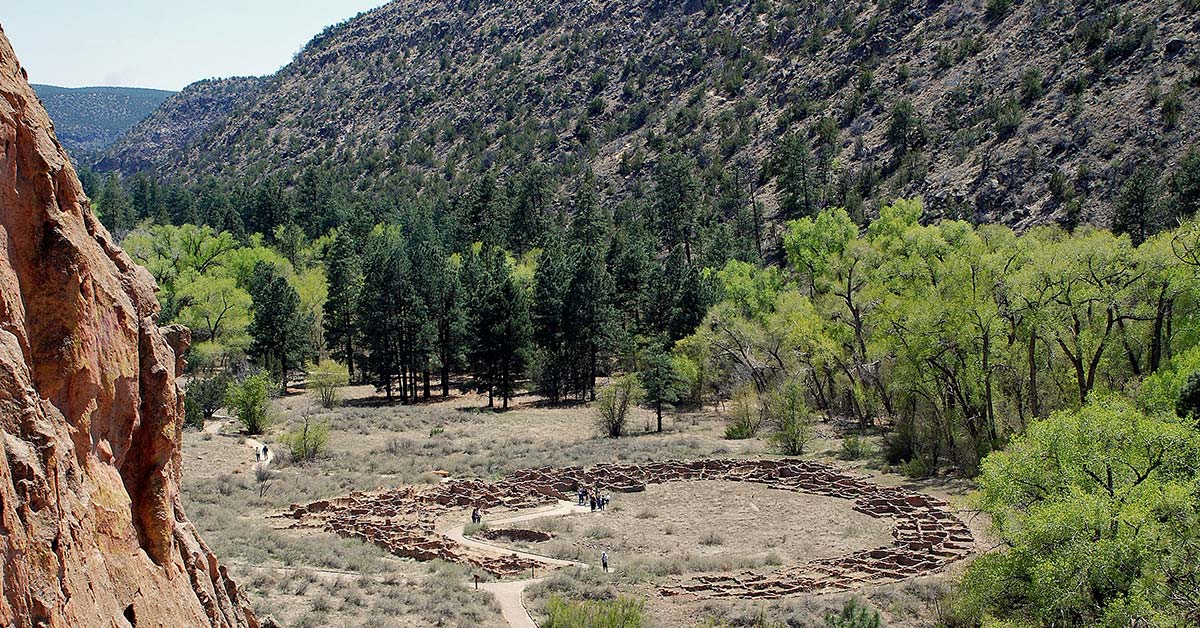
One of the most impressive stops on the Pueblo Loop Trail is Tyuonyi, a large circular village on the floor of Frijoles Canyon.
Today, low stone walls trace the outline of the rooms, but imagining the site when it was occupied transforms the experience. Hundreds of rooms once surrounded a central plaza, creating a community very different from the scattered ruins visible today.
The canyon provided important resources. Frijoles Creek offered water, agricultural fields could be cultivated nearby and on the mesas above, and the cliffs themselves provided building materials and places for additional rooms.
From higher points on the trail, you can look down across Tyuonyi and begin to understand how the village, cliff dwellings, creek, fields, and canyon worked together as one cultural landscape.
4. Climb Into Bandelier's Cavates
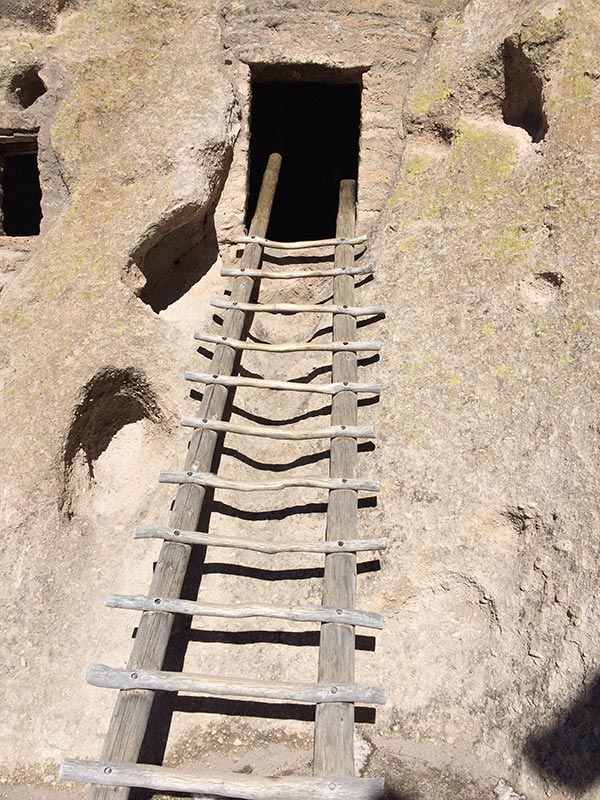
One of the features that makes Bandelier so distinctive is the opportunity to climb wooden ladders into several small cliff rooms along the Pueblo Loop Trail.
These rooms are commonly called cavates — a word combining "cave" and "excavate."
They are not simply natural caves. Ancestral Pueblo people enlarged and shaped openings in the relatively soft volcanic tuff, creating rooms that were often incorporated into larger masonry structures built against the cliffs.
More than a thousand cavates have been identified in the walls of Frijoles Canyon alone.
Some ceilings appear blackened by soot. Researchers believe soot may have served a practical purpose by helping seal the crumbly volcanic surface and reducing the amount of grit falling from the ceiling.
Only enter cavates specifically opened to visitors and reached by designated ladders. These archeological resources are fragile, and even seemingly minor contact can contribute to their deterioration.
5. Climb to Alcove House
For visitors comfortable with heights and ladders, Alcove House is one of Bandelier's most memorable experiences.
Located roughly a mile from the visitor center, Alcove House sits about 140 feet above the floor of Frijoles Canyon in a large natural alcove.
Reaching it requires climbing a series of stone stairs and four long wooden ladders. At the top, visitors find a reconstructed kiva along with niches and holes associated with structures that once occupied the alcove.
The National Park Service estimates that approximately 25 Ancestral Pueblo people once lived here.
Standing in the alcove also raises an interesting question: imagine making that climb not once as a visitor, but repeatedly while carrying food, water, tools, or children.
Before You Climb: Alcove House requires steep ladder climbing and is not appropriate for everyone. Check current conditions and closures at the visitor center before starting the hike.
6. Explore Tsankawi
Visitors with additional time should consider Tsankawi, a detached section of Bandelier National Monument located about 12 miles from the main Frijoles Canyon area.
Tsankawi offers a very different experience. Its roughly 1.5-mile trail follows the mesa top and includes petroglyphs, cavates, sweeping views, narrow pathways worn deeply into volcanic rock, and the ancestral village of Tsankawi.
Ladders are a required part of the route, and the trail is much more exposed to sun, wind, thunderstorms, snow, and other weather than the main canyon.
The well-worn paths are among the site's most fascinating features. Generations of footsteps helped carve deep channels into the soft volcanic tuff, creating trails that literally preserve evidence of repeated human movement across the mesa.
7. Discover Bandelier's Volcanic Landscape
The archeology of Bandelier makes more sense when you understand the geology.
Much of the Pajarito Plateau was shaped by enormous volcanic eruptions associated with the nearby Valles Caldera. Layers of volcanic ash compacted into a relatively soft rock called tuff.
Over time, water carved deep canyons through the plateau. The softness of the tuff also made it possible for Ancestral Pueblo people to enlarge natural openings in the canyon walls and create cavates.
The monument spans an impressive range of elevations, from areas near the Rio Grande to Cerro Grande, which rises above 10,000 feet. That elevation change creates markedly different environments within a relatively compact area.
High desert, piñon-juniper woodland, ponderosa pine forest, mountain meadows, canyon streams, and higher-elevation forests all contribute to Bandelier's biological diversity.
8. Go Beyond the Archeological Sites
It's easy to think of Bandelier primarily as an archeological park, but most of the monument is far removed from the developed area of Frijoles Canyon.
More than 70 miles of trails extend through the monument and connect with surrounding public lands. Hikers can explore canyon bottoms, mesa tops, waterfalls, volcanic landscapes, forested high country, and remote archeological sites.
Shorter options include trails near Frijoles Canyon, while longer routes such as the Frey Trail, Frijolito Loop, Tyuonyi Overlook, and Cerro Grande provide opportunities to see a much broader side of Bandelier.
Backcountry travel requires more preparation. Elevation, summer heat, afternoon thunderstorms, winter snow, wildfire conditions, and limited cell service can all affect a hike.
High-Desert Travel Tip: Bring more water than you think you'll need, use sun protection, and allow time to adjust to the elevation. During summer, start longer hikes early and watch the sky for developing afternoon thunderstorms.
9. Look for the Legacy of the Civilian Conservation Corps
Bandelier preserves another fascinating chapter of American history that is much more recent than the ancestral sites.
Beginning in the 1930s, Civilian Conservation Corps crews transformed visitor access to Frijoles Canyon. They built roads, trails, residences, visitor facilities, and other structures while also helping archeologists stabilize important sites.
Many of the buildings were constructed from local stone in a Pueblo Revival architectural style intended to complement the landscape and regional building traditions.
Over roughly eight years, CCC workers constructed dozens of stone buildings and even created much of the furniture, metalwork, and other details used inside them.
Today, Bandelier preserves one of the largest and most significant collections of CCC buildings in the National Park System, and the historic district has been designated a National Historic Landmark.
When Is the Best Time to Visit Bandelier National Monument?
Bandelier is open throughout the year, and each season creates a different experience.
Bandelier by Season
- Spring: Comfortable hiking temperatures, emerging vegetation, and generally lighter crowds than midsummer.
- Summer: Long days and full visitor services, but also heat, high elevation sun, and afternoon thunderstorms.
- Fall: Cooler temperatures, changing foliage, and excellent conditions for hiking and photography.
- Winter: Quiet trails, occasional snow, cold temperatures, and a completely different view of the canyon and archeological sites.
Summer is typically the busiest season, and Bandelier may operate a seasonal shuttle to help manage congestion in Frijoles Canyon. Shuttle schedules and requirements can change, so check current National Park Service information before your trip.
How Much Time Do You Need at Bandelier?
A half day is enough to visit the museum and walk the Pueblo Loop Trail, but a full day is much better if this is your first visit.
A Good One-Day Bandelier Itinerary
- Visitor Center: Begin with current conditions and an introduction to Bandelier's history.
- Pueblo Loop Trail: Explore Tyuonyi, Long House, the Big Kiva, and the cavates.
- Alcove House: Add the ladder climb if you're comfortable with heights and conditions allow.
- CCC Historic District: Take time to notice the remarkable stone architecture surrounding the visitor center.
- Additional Hike: Choose the Frey Trail, Falls Trail, or another route based on time and current conditions.
- Tsankawi: If you have additional time, explore this separate and very different section of the monument.
Planning Your Visit to Bandelier National Monument
Bandelier is about an hour from Santa Fe, roughly 30 minutes from Los Alamos, and approximately two hours from Albuquerque, making it an easy addition to a northern New Mexico road trip.
The monument charges an entrance fee, and America the Beautiful passes are accepted. During busy periods, seasonal shuttle service may operate between parking areas and the Frijoles Canyon visitor center.
Cell service can be very limited in and around Frijoles Canyon, so download maps and save any digital passes or important information before arriving.
Pets are generally not permitted on Bandelier's hiking trails, although they are allowed in certain developed areas such as campgrounds and parking areas when regulations are followed.
Most importantly, remember that Bandelier is both an archeological landscape and a place of continuing cultural importance. Stay on designated trails, never touch petroglyphs, don't climb on masonry walls, and leave artifacts exactly where you find them.
Frequently Asked Questions About Bandelier National Monument
What is Bandelier National Monument known for?
Bandelier is best known for its Ancestral Pueblo archeological sites, including Tyuonyi Pueblo, cliff dwellings, cavates carved into volcanic tuff, petroglyphs, kivas, and the elevated Alcove House. It also protects more than 33,000 acres of canyons, mesas, wilderness, wildlife habitat, and historic Civilian Conservation Corps architecture.
How old are the cliff dwellings at Bandelier?
The major Ancestral Pueblo occupation of the Bandelier area dates roughly from A.D. 1150 to 1550, although evidence of human activity in the region extends back more than 11,000 years.
What is a cavate at Bandelier?
A cavate is a human-carved room excavated into the relatively soft volcanic tuff cliffs. Ancestral Pueblo people enlarged natural openings and incorporated many of these rooms into larger structures built against the canyon walls.
Can you climb into the cliff dwellings at Bandelier?
Visitors may climb ladders into a small number of cavates that are specifically open to the public along designated trails. Never enter closed rooms or climb on archeological structures.
How long is the Pueblo Loop Trail?
The Pueblo Loop Trail is approximately 1.4 miles round trip. Most visitors spend at least 45 minutes to an hour exploring the trail, although photographers and visitors reading the interpretive information may want considerably longer.
How difficult is the climb to Alcove House?
Alcove House sits about 140 feet above Frijoles Canyon and requires visitors to climb stone stairs and four long wooden ladders. The route can be challenging for anyone uncomfortable with heights or steep ladders.
Is Bandelier National Monument worth visiting?
Absolutely. Bandelier combines accessible Ancestral Pueblo archeological sites, dramatic volcanic scenery, hiking, cultural history, wildlife, and some of the finest Civilian Conservation Corps architecture in the National Park System. Its proximity to Santa Fe and Los Alamos also makes it relatively easy to include in a northern New Mexico itinerary.
How much time should you spend at Bandelier?
Plan at least half a day to explore the visitor center and Pueblo Loop Trail. A full day provides enough time to add Alcove House, another hike, the CCC Historic District, or the Tsankawi section.
Is Bandelier close to Santa Fe?
Yes. Bandelier National Monument is approximately an hour's drive from Santa Fe, depending on traffic and road conditions.
Do you need to take a shuttle at Bandelier?
Bandelier operates seasonal shuttle service during periods of heavier visitation to reduce congestion in Frijoles Canyon. Schedules and requirements can vary, so check the National Park Service's current transportation information before visiting.
What is the difference between Bandelier and Mesa Verde?
Both preserve important places associated with Ancestral Pueblo peoples, but they represent different landscapes, communities, and periods of occupation. Mesa Verde is especially famous for large cliff dwellings constructed beneath sandstone alcoves, while Bandelier features villages, masonry structures, and rooms carved directly into volcanic tuff. Visiting both reveals just how diverse Ancestral Pueblo communities and architecture were across the Southwest.
A Landscape Where the Past Is Still Present
Bandelier National Monument is more than a collection of ruins.
Walk through Tyuonyi and you begin to see the outline of a community. Climb a wooden ladder into a cavate and the volcanic cliffs become architecture. Look closely at a petroglyph and you're reminded that people were leaving their mark on this landscape centuries before Bandelier became a national monument.
Then look beyond the archeological sites.
The same canyon opens into miles of wilderness. Volcanic mesas rise toward the Jemez Mountains. Historic CCC buildings tell another chapter of America's preservation story. And nearby Pueblo communities maintain ancestral relationships with these places today.
That's what makes Bandelier special: thousands of years of human history layered into one extraordinary New Mexico landscape.
